
Even the UK's most celebrated stock-pickers beat the market over their lifetimes. But most investors who backed them still lost out on those active fund returns. The culprit isn't just fees — it's timing. Jeremy Warner's recent broadside against fund manager Terry Smith in the Telegraph pulled no punches. Investors paying management fees "between 0.9pc and 1.5pc," he wrote, now "wonder why they are forking out" when they "can get superior performance from indexed and exchange traded funds for a fraction of the price." But Warner missed the real scandal. Fundsmith Equity has delivered 13.8% annualized since November 2010 — beating the MSCI World Index by 1.7 percentage points over 15 years. Nick Train's WS Lindsell Train UK Equity Fund returned 426% since August 2006, crushing the FTSE All-Share's 251%. By conventional measures, successful active managers who beat their benchmarks. Yet virtually no investors captured those active fund returns. Most bought after years of stellar performance, then watched their capital shrink as both funds reverted to the mean. The gap between what funds reported and what investors received is perhaps the clearest argument against active management. The problem isn't fees. It's timing.
What you earn vs what funds report
Funds report "time-weighted returns" — what you'd earn investing a lump sum on day one and never touching it. Clean. Comparable. Meaningless for most investors. Real investors add money after reading about success. Pull it out when performance disappoints. Chase last year's winners. The return that compounds in your account is the "dollar-weighted return." This accounts for when you bought and sold, and how much you had invested during different periods. The gap reveals an uncomfortable truth: investor behaviour destroys returns more reliably than any other factor. The problem isn't that active fund returns don't exist on paper — it's that almost no one actually earns them.
"The gap reveals an uncomfortable truth: investor behaviour destroys returns more reliably than any other factor."
A simple example: a fund delivers 10% in year one, 10% in year two, then drops 10% in year three. Time-weighted return: 2.9% annualized. But invest £1,000 in years one and two, then £3,000 in year three (scared of missing out), and your dollar-weighted return becomes negative 0.4%. Less money than you put in, despite the fund showing a positive return. This pattern repeats everywhere.
The evidence is systematic
Morningstar's Mind the Gap research has tracked this phenomenon globally since 2005, comparing what funds report with what investors actually earn. In the UK market, investors earned about 0.32 percentage points less per year than their funds over the five years through June 2023. That compounds: a 0.32% annual shortfall on £100,000 over 20 years costs roughly £12,500. Aggregate figures mask brutal gaps in volatile categories. UK equity funds, global growth funds and sector strategies all showed negative gaps, with concentrated funds suffering worst. Three patterns emerge. Volatility amplifies the problem. The more a fund swings, the worse investors time their moves. Calm funds produce narrow gaps. Violent funds produce wide ones. The gap persists across market cycles. Not just panic during crashes. It compounds quietly, year after year, in bull markets and bear markets alike. Diversified allocation funds show the narrowest gaps, concentrated strategies the widest. Balanced funds don't produce spectacular swings that trigger panic or euphoria. That's precisely why they work. This isn't about investor ignorance. It's human psychology meeting market volatility. Two of the UK's most celebrated fund managers provide textbook case studies.
When star managers attract the wrong money
Fundsmith and Lindsell Train follow nearly identical trajectories, demonstrating how even successful active management fails most investors. 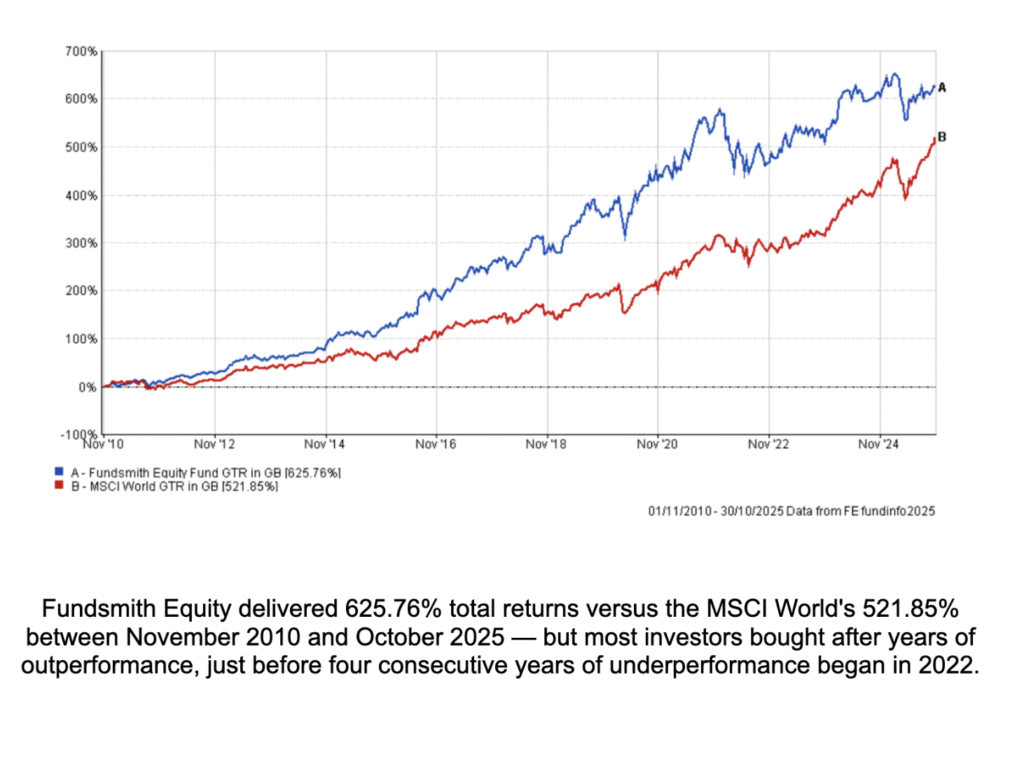 Fundsmith Equity delivered 625.76% total returns versus the MSCI World's 521.85% between November 2010 and October 2025 — but most investors bought after years of outperformance, just before four consecutive years of underperformance began in 2022. Fundsmith attracted peak inflows between 2019 and 2021, swelling assets beyond £25 billion. Investors had watched Terry Smith deliver 25.76% in 2019, 18.41% in 2020 and 22.23% in 2021. The fund seemed unstoppable. Then the reversal. Four consecutive years of underperformance. The fund dropped 13.71% in 2022 while the MSCI World fell only 7.7%. It gained 12.48% in 2023 against the index's 16.8%. In 2024, it managed 8.98% while the index surged 20.8%. Between December 2023 and December 2024 alone, investors yanked £3.31 billion. By September 2025, assets had collapsed to £17.9 billion.
 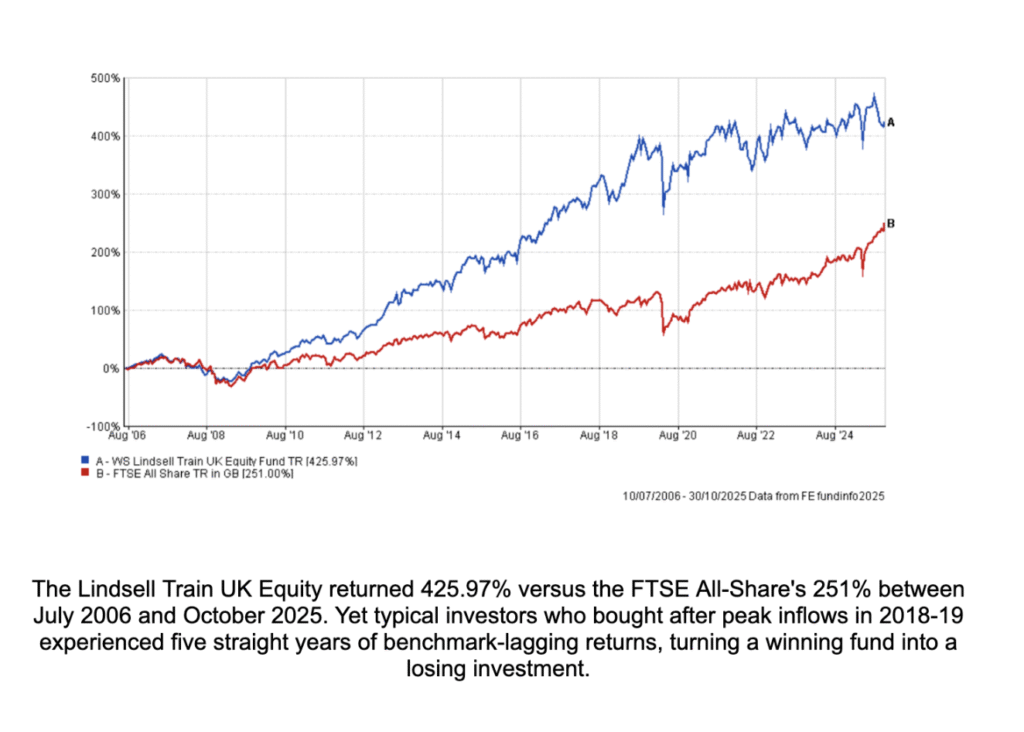 The Lindsell Train UK Equity returned 425.97% versus the FTSE All-Share's 251% between July 2006 and October 2025. Yet typical investors who bought after peak inflows in 2018-19 experienced five straight years of benchmark-lagging returns, turning a winning fund into a losing investment. Lindsell Train saw its largest inflows in 2018 and 2019 — £1.95 billion and £2.3 billion respectively. The timing proved catastrophic. Five consecutive years of underperformance followed: 0.81 percentage points behind the FTSE All-Share in 2020, 9.64 points in 2021, 0.73 points in 2022, 3.70 points in 2023 and 3.56 points in 2024. By 2021, outflows reached £1.81 billion annually. Nearly £5 billion swung from enthusiasm to panic. The typical investor's reality:
"The cruel irony is that both funds still beat their benchmarks since inception. But the capital didn't arrive on day one. It arrived a decade later, just as the winning streaks ended."
Invest £10,000 in Fundsmith at the start of 2020 — after years of success — and you'd have roughly £15,300 by end-2024. That's 8.9% annualized, with considerably more volatility than a simple global tracker. Invest £10,000 in Lindsell Train at end-2019 and you'd have approximately £11,140 by end-2024. That's 2.2% annualized over five years. A FTSE All-Share tracker charging a tenth of the fee would have delivered 5.7% annualized. The gap: 3.5 percentage points per year, compounding relentlessly. The cruel irony is that both funds still beat their benchmarks since inception. But the capital didn't arrive on day one. It arrived a decade later, just as the winning streaks ended.
Why active fund returns fail most investors
"Active funds face an inescapable problem: capital arrives after performance, not before. The money shows up precisely when it can benefit least."
Fundsmith and Lindsell Train aren't aberrations. They're what happens when active management meets human psychology. Jack Bogle spent decades documenting this. "The miracle of compounding returns," he wrote, "is overwhelmed by the tyranny of compounding costs." The biggest cost isn't the management fee. It's buying high and selling low. The chain of events virtually guarantees poor outcomes: Outstanding performance attracts media attention. Financial advisers recommend the fund. Assets flood in. But by now, the manager's best ideas are fully sized, the portfolio has grown unwieldy and mean reversion looms. Market conditions shift. The fund lags. Investors wait, giving the manager the benefit of the doubt. After 12 to 18 months of persistent underperformance, patience evaporates. Advisers worry about career risk. Outflows begin. This isn't a failure of skill. It's failure of timing, multiplied across millions of investor decisions. Tony Dye's experience at Phillips and Drew offers historical precedent. In the late 1990s, Dye refused to participate in the tech bubble, correctly predicting it would burst. His vindication came too late. Years of underperformance cost Phillips and Drew clients and ultimately cost Dye his job. Being right eventually offered cold comfort to investors who'd already fled. Active funds face an inescapable problem: capital arrives after performance, not before. The money shows up precisely when it can benefit least.
Fees multiply the damage
The behavioural gap exists before fees. But fees compound the timing problem. Fundsmith charges roughly 1.0% annually. Lindsell Train's ongoing charge sits at 0.67%. Equivalent passive trackers charge as little as 0.10%. Return to the Lindsell Train example. The typical 2019 investor earned 2.2% annualized through 2024, paying 0.67% in fees. Strip those out and the underlying performance becomes roughly 2.9% annualized. A FTSE All-Share tracker delivered 5.7% annualized, charging 0.10%, for net returns around 5.6%. Fee differential: 0.57 percentage points. Performance gap: 3.4 percentage points. Fees account for only a sixth of the shortfall. Poor timing accounts for the rest. But fees still matter. They compound relentlessly. Over 20 years, the fee differential alone costs roughly £180,000 on an initial £1 million investment growing at market rates. Add the behavioural gap and the wealth destruction becomes staggering.
The evidence-based alternative
The solution requires abandoning the search for star managers. Evidence-based investors build portfolios from low-cost index funds, allocate according to simple diversification principles and rebalance systematically. No star manager to follow. No concentrated bet that might blow up. Just broad market exposure at minimal cost. Morningstar's research proves this works. Allocation funds — balanced offerings combining stocks and bonds — consistently show the smallest investor return gaps. They don't produce spectacular swings that trigger panic selling or euphoric buying. That's why they work. For UK investors, a straightforward combination delivers everything necessary: low-cost global equity trackers, UK equity trackers and bond funds. Broad diversification across thousands of companies. Minimal costs. Tax efficiency through accumulation share classes and ISA wrappers. And crucially, no emotional triggers for mistimed trades. Rebalancing enforces the opposite behaviour that destroys returns. Instead of buying high and selling low, systematic rebalancing forces you to buy low and sell high. Sell what's done well. Buy what's lagged. Repeat. This won't generate dinner party stories about your prescient Tesla bet. But it works. Reliably. Predictably. Boringly.
The true believers won't save you
The committed early investor in Fundsmith or Lindsell Train might object: "I bought at inception and held. I beat the benchmark." True. A tiny minority did. They're statistical outliers. Fund flow data makes this unambiguous. Fundsmith attracted peak inflows roughly 10 years after its November 2010 launch. Lindsell Train saw peak inflows 12 to 13 years after its August 2006 launch. Most capital arrived well after the glory years. Even inception investors face narrowing margins. Warner noted that while Fundsmith's annualized return since inception still beats the MSCI World Index, "whatever outperformance Smith has achieved is entirely down to his early years of operation." Since 2021, the fund has lagged consistently. Lindsell Train's 108-month top-quartile streak ended in 2025 after five consecutive years of underperformance. The gap between reported returns and inception-investor returns keeps shrinking. The relevant question isn't whether some investors did well. It's whether active management serves most investors well. The evidence says no.
What actually matters
Most investors believe superior fund performance means superior investor outcomes. They assume that impressive active fund returns on paper translate to wealth in their accounts. The evidence proves otherwise. What matters isn't what the fund reports. It's what you actually earn. And that depends overwhelmingly on when you buy and sell. Fundsmith and Lindsell Train are instructive precisely because both succeeded on their own terms. They beat benchmarks over their lifetimes. They followed disciplined processes. Their managers articulated clear philosophies and invested their own money alongside clients. None of that protected investors from the tyranny of poor timing.
"The investor return gap persists regardless of skill, strategy or philosophy. It's not a bug of active management. It's a feature."
Morningstar's research shows this pattern holds everywhere — across markets, time periods and fund categories. The investor return gap persists regardless of skill, strategy or philosophy. It's not a bug of active management. It's a feature. The alternative requires less sophistication, not more. Build a diversified portfolio of low-cost trackers. Hold through market cycles. Rebalance. Ignore the noise about star managers and hot sectors. The data on active fund returns is unambiguous: chasing them costs more than they deliver. This won't generate excitement. But it will reliably generate wealth. For most investors, that should be enough. Professional financial guidance can help structure a portfolio based on evidence rather than hope. The evidence shows that boring wins.
You've seen through the performance theatre. Now what?
Reading about hidden fees and the gap between advertised active fund returns and what investors actually earn is useful. Actually extracting yourself from expensive mediocrity and building something better — that requires a different kind of support. rockwealth Cardiff exists for investors who've had enough of complexity taxes and fiduciary fog. We practice evidence-based investing because it's the only honest approach that consistently works: own the market through low-cost index funds, diversify properly, and avoid the behaviour traps that destroy returns. What separates adequate from genuinely useful financial planning is understanding that investment strategy should be dictated by your specific goals, timeline, and tolerance for genuine drawdowns — not by what performed well last year or which funds pay the best commissions. If you're ready to work with someone who'll tell you what you need to hear rather than what's easiest to sell, contact us to arrange an exploratory meeting.