


10 ways to lead a more sustainable life
Around the world, communities, corporations, and governments have all turned to sustainability as a major issue.
One of the most significant issues of this century is climate change and its effects on the future. The "COP26" United Nations Climate Change Conference will take place in the UK in 2021. The goal of COP26 is to persuade nations to take action in order to limit the rise in global temperature this century to less than 2 degrees Celsius above pre-industrial levels. Global ecosystems are expected to undergo irreversible changes if temperatures climb above this level.
Although significant, a sustainable lifestyle involves much more than just addressing climate change. It involves controlling how natural resources are used in order to maintain long-term ecological balance. Reducing deforestation, recycling priceless materials used in technology, or utilising sustainable energy sources are a few examples of how to do this. Sustainable business practises can raise global living standards and protect the environment for future generations.
Although some sustainability concerns may appear to be enormous, there are things that people can do to lessen their effects on the environment and society.
How sustainable is your life?
According to a survey from Pru, 55% of UK adults say they live sustainably. When asked what specific action they are taking to live a sustainable life, the responses included: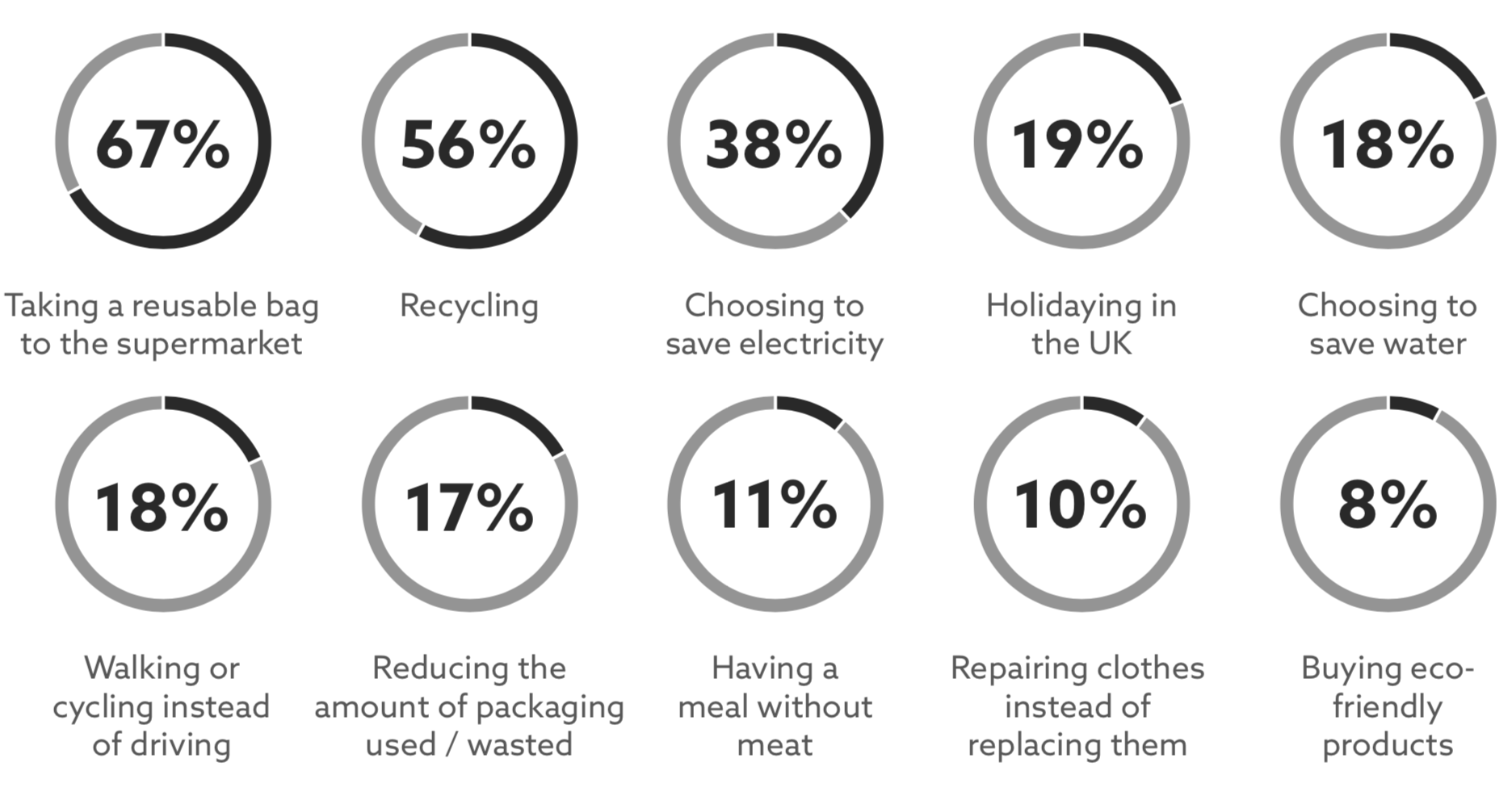 Thinking about the impact your choices have on the wider environment can help you identify where you can make meaningful changes. Even small, consistent changes can add up, especially when they’re done collectively. The move to limit the number of single-use plastic shopping bags in the UK is a great example of this. The government introduced a 5p charge in 2015 to encourage shoppers to use reusable shopping bags. Within five years, the government figures show that plastic carrier bag sales fell by more than 95%. The average person in the UK now buys around four bagsrna year from the largest supermarkets. This compares to 140 in 2014. It’s a small change to an individual’s shopping habits but the impact adds up.If you’re looking for ways to improve your sustainability credentials, here are 10 ideas that could help you.
1
Keep “reduce, reuse, recycle” in mind
Even though the three R's — reduce, reuse, and recycle — have been around for a while, they remain a crucial way of thinking for sustainability. When determining whether to buy something or what to do with it, keeping these three possibilities in mind can help the environment.- Reduce: Do you really need to buy a new item? Whether it’s a single-use item or not, reducing consumption can have a positive impact on the environment. - Reuse: Can an item be reused or repaired to extend its lifecycle? If it’s not something you can reuse, could someone else or a charity benefit from it? - Recycle: Where an item can’t be reused, can it be recycled? From adding recyclable materials to your recycling bin at home to sending a mobile phone to be recycled, you can give products a new lease of life.
2
Take steps to make your home more energy-efficient
 You're not the only one who wants to make your house more energy-efficient. 96% of UK homeowners, according to research from the Energy Saving Trust, are worried about how energy-efficient their house is. Homes that aren't energy efficient result in higher energy costs and unneeded CO2 production for households. Although both the current and previous governments have stressed the importance of expanding the UK's housing stock, statistics indicate that we are falling short of this objective. A BBC report claims that over two-thirds of UK households fall short of long-term energy efficiency goals. More than 12 million homes received Energy Performance Certificates (EPC) that were less than grade C in 2020. Which changes will improve your home’s EPC rating will depend on the property. As a general rule, newer properties will need fewer updates than those built before 1990. Some of the improvements that can have a large impact on energy efficiency include: - Insulating your roof
- Insulating your walls
- Draught-proofing windows
- Upgrading your boiler An EPC will show your home’s energy performance score, as well as a list of recommended improvements with their estimated cost savings. This can help you see which projects are worth investing in. Small steps can have an impact too. From switching to efficient light bulbs to choosing efficient appliances, little changes can reduce the amount of energy you use.
You're not the only one who wants to make your house more energy-efficient. 96% of UK homeowners, according to research from the Energy Saving Trust, are worried about how energy-efficient their house is. Homes that aren't energy efficient result in higher energy costs and unneeded CO2 production for households. Although both the current and previous governments have stressed the importance of expanding the UK's housing stock, statistics indicate that we are falling short of this objective. A BBC report claims that over two-thirds of UK households fall short of long-term energy efficiency goals. More than 12 million homes received Energy Performance Certificates (EPC) that were less than grade C in 2020. Which changes will improve your home’s EPC rating will depend on the property. As a general rule, newer properties will need fewer updates than those built before 1990. Some of the improvements that can have a large impact on energy efficiency include: - Insulating your roof
- Insulating your walls
- Draught-proofing windows
- Upgrading your boiler An EPC will show your home’s energy performance score, as well as a list of recommended improvements with their estimated cost savings. This can help you see which projects are worth investing in. Small steps can have an impact too. From switching to efficient light bulbs to choosing efficient appliances, little changes can reduce the amount of energy you use.
Improving energy efficiency could boost your home’s value
An Energy Performance Certificate (EPC) rates a property’s energy efficiency from A–G. The average rating in the UK is D.
If your home’s EPC is low, energy- efficient measures could be an investment. Which? found that buyers are increasingly willing to pay a “green premium” and homes with high energy efficiency ratings are worth up to £40,000 more than less efficient properties.
3
Choose renewable energy
Not only how much energy we use, but also where it originates from, is crucial. The UK is progressively embracing renewable energy sources that can lessen your environmental impact. According to government statistics, renewable energy sources supplied more than a third of the UK's energy requirements in the second quarter of 2021. Your carbon footprint can be decreased by switching to a renewable energy supplier. If you want all of your energy to originate from renewable sources, you now have many options to select from. Numerous other providers are also increasing the proportion of renewable energy that they use. Choosing a green supplier does not guarantee a rise in your energy costs. But you should evaluate prices. For some properties, adding renewable energy sources makes sense too. Could your home benefit from solar panels? Or could an air source heat pump cut your heating bill? While these measures can be a costly investment they can pay for themselves over the long term.
4
Save water where you can
How much water do you use every day?
According to a Water UK poll, 46% of respondents think their home consumes fewer than 20 litres per day. That is far less than the suggested daily intake of 142 litres for one person. It's simple to take water for granted because it's easily available in homes across the UK. But we must safeguard it since it is a valuable resource. We are more likely to experience periods of water stress than in the past due to the increased frequency of droughts across the UK and the rest of Europe. Water use management is therefore essential for long-term sustainability. It takes a lot of energy to treat and pump water, as well as to heat the water in your home. Utilising less water might also help you spend less energy. Installing measures like the below can help reduce how much water you use:
- Choosing an energy-efficient shower head
- Fitting flow regulators or aerators to taps
- Installing water-efficient toilets
- Choosing low-flow taps
- Harvesting rainwater to meet gardening needs.
Livestock, especially beef, makes a huge contribution to the plant’s greenhouse gas emissions. Various research has highlighted how embracing a vegetarian or vegan diet is one of the single biggest things that an individual can do to reduce their carbon footprint.
Research from the University of Oxford from 2018, for instance, estimated that cutting out meat and dairy products from your diet could reduce your carbon footprint by up to 73%. As well as reducing greenhouse gas emissions, the research suggests it could reduce the amount of global farmland needed.
You don’t have to become vegetarian or vegan for your diet habits to have a positive impact on the environment. Opting for a few meat-free days a week can reduce your carbon footprint.
How you spend your money will impact how your lifestyle affects the environment and communities around the world. Next time you make a purchase, taking a closer look at labels can help your shopping habits become more sustainable. Opting for fair trade products is one of the most common steps you can take. Fair trade products show that farmers and other workers have received fair terms. This could mean better prices for their produce or safer working conditions, as well as practices that support local sustainability. You could also check clothing labels to see which items have been made from sustainable cotton, or choose products that are free from palm oil, which is associated with deforestation. Alternatively, purchasing food and other items from local suppliers or businesses could mean your purchases have a lower carbon footprint.It’s common knowledge that cars don’t provide a carbon-efficient way to travel. While it’s not practical to ditch cars completely for most people, a few changes to daily habits can reduce carbon emissions. Could you use public transport to get to work a few days a week rather than driving there? Are there local shops you can walk to when you need a few bits rather than driving to a supermarket? Lockdowns due to Covid-19 highlighted the impact that commutes, and other lifestyles choices, have on the environment. According to a report in the i News, lockdowns led to a 10% drop in UK carbon emissions during 2020. Of course, switching to a hybrid or electric vehicle could reduce your impact on the environment too. The government has set a target of ending the sale of new petrol or diesel cars by 2030.Even after taking steps to reduce your emissions, your day-to-day life will still have an impact. Offsetting your emissions is a way to invest in an environmental project to balance out your carbon footprint. This could mean investing in a project that is planting more trees or rolling out clean energy alternatives. It’s an option you can consider to offset day-to- day emissions, like the energy used to heat your home, or after a specific activity, like flying on holiday. While offsetting is becoming more popular, it is also controversial. Some projects that claim to offset emissions may only have a limited impact and there are also scams out there. So, it’s important to choose a reliable organisation when offsetting emissions and understand the impact your money will have.
9
Invest sustainably
Just as you can choose to spend money in ways that favour sustainability, so too can your investment strategy. Incorporating sustainability concerns into your investment strategy is becoming more and more popular, and there are several different ways to do it. One method is referred to as "ESG investing," where traditional criteria plus environmental, social, and governance concerns are taken into account. The Investing Association estimates that in 2020, UK investors will contribute about £1 billion each month on average to "ethical investment vehicles." Aligning your assets with your values can be accomplished through the practise of ESG investing. For instance, it can entail avoiding particular sectors, like the arms sector, or investing in businesses that are setting the standard for renewable energy. This could mean your investment has a positive impact on the world. Your objectives and investing risks must be considered, though. Even if the assets seem appealing from an ESG perspective, the measures you would typically take to determine if an investment is good for you still need to be taken. It's critical that you're assuming the right level of risk for you while investing because investment values might change. Keep in mind that you don't have to alter your entire financial portfolio. For instance, you might want to add some ESG funds to your present portfolio. It's crucial to put together a portfolio that accurately reflects your objectives.
The challenge of spotting “greenwashing”
Sustainable investing is referred to by a variety of names, and it may be harder to identify those that will actually have an impact than you may expect.
Using false information or titles to make a company or investment appear more environmentally friendly is known as "greenwashing." A Triodos Bank UK poll found that 26% of customers who do not presently participate in an ethical fund wonder if the investments are actually ethical.
10
Switch your pension to a sustainable fund
You should consider your pension in addition to changing your investments to more sustainable ones. Your pension will typically be invested, and making it sustainable could have a far bigger effect than you might think. One of the biggest assets for many people ends up being their pension. Along with personal contributions throughout the course of your working career, it also includes employer payments, tax breaks, and investment returns. Therefore, the way it is invested can significantly affect sustainability-related issues. The Make My Money Matter campaign claims that selecting a sustainable pension fund is one of the best things you can do for the environment. An average pension of £30,000 is thought to provide for the annual reduction of 19 tonnes of carbon. In fact, it has been determined that altering your pension investment strategy may be 21 times more beneficial than driving an electric vehicle, utilising renewable energy sources, and being vegan all at once. Although changing your pension is frequently straightforward, you should first give it some thought. You should be informed of the potential hazards and long-term effects because it would alter how your pension is invested.
How do you switch your pension?
If you have a defined contribution (DC) pension, you will usually have several funds to choose from. These will often have different risk profiles and many providers now offer a sustainable option.
You can usually change which fund your pension is invested in through an online account, or by calling your pension provider.
Make your finances more sustainable
Please get in touch with us if you're interested in talking about sustainability in relation to your pension, investments, and savings. Rockwealth Cardiff is here to assist you in comprehending your possibilities and developing a plan that takes into account your objectives and situation.